
Transcript
Announcer:
You’re listening to GLC on ReachMD. This activity is provided by Global Learning Collaborativeand is part of our MinuteCE curriculum.
Prior to beginning the activity, please be sure to review the faculty and commercial support disclosure statements as well as the learning objectives.
Dr. Rubin:
Anti IL-12/23 and anti-IL-23 therapies represent a more selective cytokine-driven approach to managing inflammatory bowel disease by targeting key cytokines that are present in many patients with Crohn's disease and ulcerative colitis. Over the years that these therapies have been developed, we've learned a lot about their safety and their efficacy and now there are multiple options on the market for us to consider for our patients who may need these therapies.
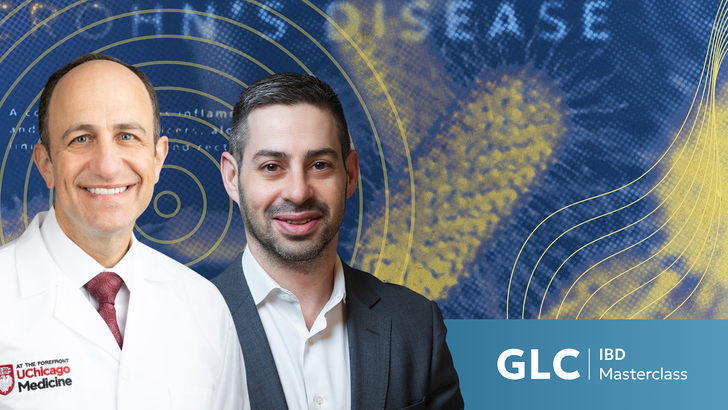
I'm Dr. David Rubin from the University of Chicago, and joining me is Dr. Michael Dolinger who's at the NYU Grossman School of Medicine. Hi Mike.
Dr. Dolinger:
How you doing?
Dr. Rubin:
I'm good. Can you give us some clues about how you think about these IL-23 targeted therapies and what you're doing in your practice?
Dr. Dolinger:
Yeah. So this is one of the most common prescribed classes of medicine that we use in clinical practice today. And this class I think has the benefit of being really effective for both Crohn's disease and ulcerative colitis throughout the GI tract. Really safe with an excellent safety profile and often with a convenient delivery mechanism that doesn't tie patients to infusions and gives them flexibility. And when you combine that with the concomitant overlap that patients have with either a family or personal history of inflammatory skin conditions, specifically psoriasis and psoriatic arthritis in these families, it makes targeting the interleukin-12/23 pathways, or more specifically interleukin-23, a really excellent treatment option for moderate to severe Crohn's disease and ulcerative colitis.
I like to explain to patients the difference in the available therapies of interleukin-12/23 and interleukin-23 that we have ustekinumab that targets both interleukin-12/23 and that revolutionized the way we practice in the late 20teens, and now we have risankizumab, guselkumab, and mirikizumab which target interleukin-23 specifically.
When we think about how they work, I think patients really understand the immunology behind this because it's relatively straightforward that they share a common subunit, the p40 subunit, and these molecules, the interleukin-12, is really located on that p40 and upregulates Th1 pathways in the immune system. And then we target the p19 subunit where our interleukin-23, and that upregulates the Th17 immune pathways. And these really play central roles in the homeostasis of the GI tract in controlling chronic inflammation as well as in the skin.
And so when I’m positioning these therapies, I'm really thinking about this as great effective, safe options for most IBD patients and I really position it as first-line when they have a personal or family history of psoriasis.
Dr. Rubin:
That work was done by one of your colleagues, and certainly is very interesting one to understand that there might be a dominant immune pathway along the IL-23 pathway in somebody who has a family history or a personal history of inflammation of the skin. That's really interesting.
But let me push you back a little bit more here. How do you choose which drug to use? Do you have certain patients that you prefer the p19 inhibitors, or that you use the tried and true p40 inhibitor?
Dr. Dolinger:
I think in Crohn's disease, with the newer drugs that target interleukin-23 comparing head-to-head in the trials with ustekinumab targeting interleukin-12/23 and showing that there is definitely a non-inferiority, let alone there is likely more endoscopic remission to the almost 10% level often, that for Crohn's disease, in my practice, when it's available, I'm choosing an interleukin-23 option, particularly when the small bowel is involved. I think the data is less clear for colitis and colonic involvement, but still with the convenient mechanisms, delivery and safety, usually choosing interleukin-23 blockers, risankizumab, guselkumab, as well as mirikizumab as options over ustekinumab in this day and age.
Dr. Rubin:
If you have a patient who's on ustekinumab and they're losing response, would you consider giving them one of the newer p19 IL-23 inhibitors?
Dr. Dolinger:
I would. I think for patients who responded to ustekinumab, where it may be less the mechanism and more the dosing, that we didn't get the dosing right in the beginning, or they lost response over time and there's a immune shift, that there is a benefit to try an interleukin-23 inhibitor in these cases.
Dr. Rubin:
We saw that here as well in our own institution, but we've seen it in the phase 3 trials when they've done those analyses, and certainly we've come to appreciate that the newer p19 IL-23s are superior to ustekinumab in Crohn's. Completely agree with everything you said there, Mike.
I do want to add one more thing, which is that interleukin-23 appears to be a cytokine that is only expressed when you are inflamed and where you are inflamed. So if it is a pathway that works for a patient with inflammatory bowel disease, the drug will work on the bowel, but it doesn't really affect your systemic immune system in a way that would put you at risk, and that's probably why we've seen such remarkable safety from these therapies.
So it's been a very nice option for us to have available to our patients, but I understand there's certainly a lot of confusion about which drugs to use, direct-to-consumer advertising, and lots of biosimilars to ustekinumab that are now on the market. So it's good to hear your perspective on this. And I love that pearl about understanding a family history of skin as a way to maybe think about this therapy.
Anybody you wouldn't give an IL-23 drug to?
Dr. Dolinger:
I think for perianal Crohn's disease as a first-line therapy, I don't think an interleukin-23 inhibitor, it would be my choice. Other than that, I don't think there's many outside of a severe colitic in the hospital that this drug would not be the right class for.
Dr. Rubin:
Well, it offers safety, and as you mentioned, the subcutaneous convenience, so something good for people to learn more about and to certainly consider for their patients.
Well, it's been really nice talking to you about this class of therapy and hopefully giving some folks new reasons to consider these and to understand how to position them in their own practice. Thanks so much for being with me today, Mike.
Dr. Dolinger:
Thank you.
Announcer:
You have been listening to GLC on ReachMD. This activity is provided by Global Learning Collaborativeand is part of our MinuteCE curriculum.
To receive your free CE credit, or to download this activity, go to ReachMD.com/CME. Thank you for listening.

 Global Learning Collaborative (GLC) designates this activity for 2.0 contact hour(s)/0.2 CEUs of pharmacy contact hour(s).
  Global Learning Collaborative (GLC) has been authorized by the American Academy of PAs (AAPA) to award AAPA Category 1 CME credit(s) for activities planned in accordance with AAPA CME Criteria. This activity is designated for 2.0 AAPA Category 1 CME credit(s). Approval is valid until 6/1/27. PAs should claim only the credit commensurate with the extent of their participation in the activity.

